
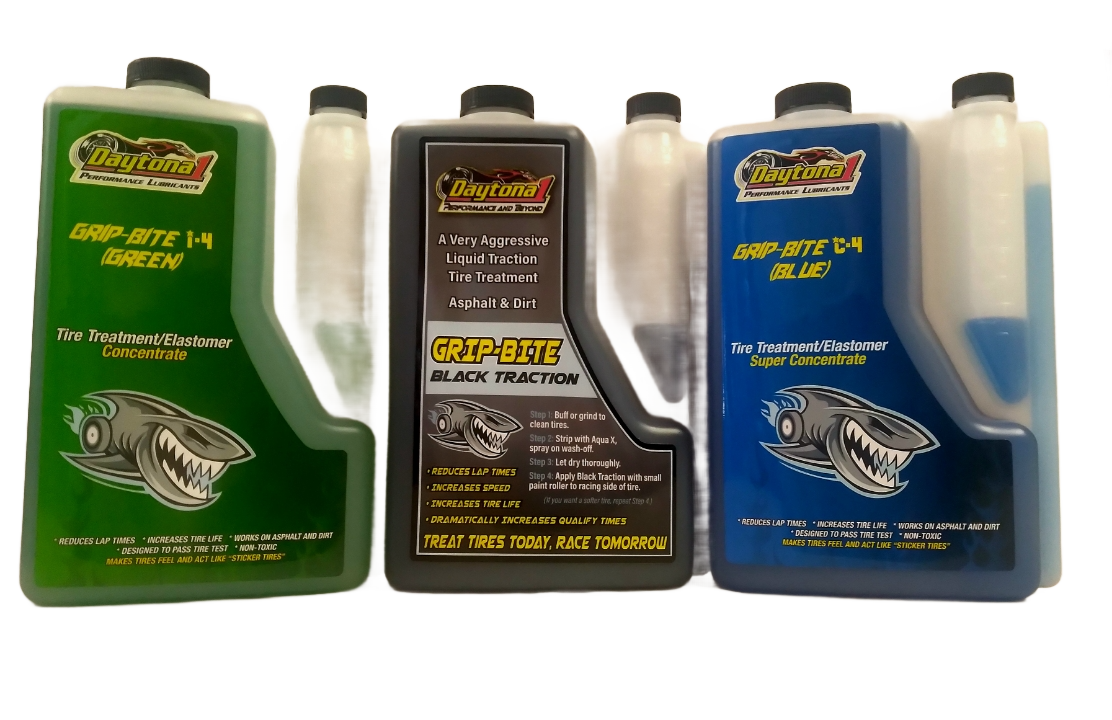
GRIP-BITE™ ADVANCED TIRE TREATMENT SYSTEMS
Modern Tire Science for a Modern Racing Environment
For decades, tire performance has been viewed as a fixed and rapidly declining asset: once a tire lost grip, it was assumed to be “used up.” But advances in polymer chemistry, surface activation techniques, and rubber rejuvenation now allow tires to be restored, reconditioned, and re-optimized in ways that were impossible with older materials and outdated treatment practices.
Grip-Bite™ was engineered to bring these advancements directly to the racing environment through non-toxic, chemically stable systems designed to:
- Improve surface compliance
- Increase mechanical grip
- Restore rubber flexibility
- Reduce micro-cracking and heat fatigue
- Provide more consistent lap-to-lap performance
Unlike older solvent-based approaches, Grip-Bite™ does not soften, melt, or degrade rubber. Instead, it works on a molecular re-bonding principle that enhances existing rubber without altering durometer beyond natural operating ranges.
THE SCIENCE BEHIND GRIP-BITE™
1. Surface Activation Layer (SAL) Technology
Rubber is a composite material made of polymers, fillers, and plasticizers. Over time, heat cycles cause:
- Polymer chain stiffening
- Plasticizer migration
- Surface hardening
- Micro-fractures that reduce mechanical loading capability
Grip-Bite™ formulations penetrate these surface layers and restore flexibility by:
- Reintroducing mobility to heat-stiffened polymers
- Re-stabilizing plasticizers
- Increasing surface compliance without breaking down tire structure
This is not “softening”—it’s reactivating the tire surface to achieve more consistent grip.
2. Molecular Re-bonding Enhancement
As tires age, polymer chains lose elasticity and become less responsive to deformation. Grip-Bite™ helps re-align these chains and increase surface bonding strength, which results in:
- Improved traction zones
- Better contact patch uniformity
- More predictable slip angles
- Reduced surface glazing
This increases mechanical grip, particularly on abrasive or low-rubber tracks.
3. Heat Management & Stabilization
Uneven heat distribution accelerates tire decay. Grip-Bite™ supports thermal stability by:
- Reducing localized hot spots
- Improving heat dissipation across the contact patch
- Maintaining optimal surface temperature
- Slowing oxidation reactions that harden rubber
This leads to longer tire life, reduced fall-off, and more repeatable performance curves.
4. Consistency Across Conditions
Grip-Bite™ treatments are engineered to provide stable results across:
- Dry slick tracks
- Heavy rubber tracks
- Varying humidity
- Low or high temperature conditions
This reduces variability and helps create a more repeatable tuning environment.
TIRE TREATMENT SYSTEMS, APPLICATION FRAMEWORK & TECHNICAL BENEFITS
GRIP-BITE™ TREATMENT SYSTEM STRUCTURE
STEP 1 — Surface Preparation Phase
A clean surface is essential for uniform penetration. The preparation phase removes:
- Track debris
- Rubber dust
- Oils and contaminants
- Glazed surface layers
This ensures the treatment bonds effectively to the polymer matrix rather than sitting on the surface.
STEP 2 — Penetration & Bonding Phase
Once applied, Grip-Bite™ begins its controlled penetration sequence:
- Molecules migrate into the upper polymer layer
- Chain mobility increases
- Micro-cracks tighten and recondition
- Surface elasticity improves
This provides the foundation for enhanced grip without structurally damaging the tire.
STEP 3 — Activation & Stabilization
After appropriate cure time:
- The polymer chain structure stabilizes
- Surface compliance equalizes across the tread
- Slip-angle behavior becomes more predictable
- Wear patterns normalize
This results in a consistent tire that behaves similarly across multiple heat cycles.
TECHNICAL ADVANTAGES OF USING GRIP-BITE™
1. Improved Mechanical Grip
Enhanced surface compliance enables the rubber to conform to microtextures within the track, increasing traction at all angles of load.
2. Reduced Performance Fall-Off
Reconditioned rubber maintains grip longer, even as heat cycles increase.
3. Enhanced Tire Longevity
Rejuvenating the upper polymer layers prevents premature hardening and cracking.
4. Stabilized Heat Cycles
Consistent heat distribution minimizes cold cracks, hot tearing, and rubber separation.
5. More Predictable Handling Characteristics
Rebalanced surface chemistry yields tighter slip-angle control and reduced under/oversteer variation.
6. Environmentally Safe & Rule-Friendly
Grip-Bite™ is formulated using non-toxic, safe chemistry designed to comply with modern expectations for clean racing practices.
MODERN TIRE TECH DEMANDS MODERN RULES
Older tire-testing methods were created to detect caustic, volatile, and hazardous chemicals—materials that are no longer part of responsible tire treatment systems.
Safe, polymer-restoration technology like Grip-Bite™ is fundamentally different.
It is non-toxic, non-volatile, and structurally compatible with modern racing tires.
Daytona 1 advocates for updated, science-driven regulations that distinguish between:
- Harmful, outdated chemicals (old treatments)
- Safe, polymer-reactive restoration systems (modern Grip-Bite™ technology)
This protects fairness, safety, and technical accuracy within the sport.
CONCLUSION
Grip-Bite™ brings modern polymer chemistry to the racing world, allowing teams to:
- Extend tire life
- Improve performance
- Control costs
- Maintain consistent handling
- Reduce environmental impact
- Align with the next generation of rule modernization
Grip-Bite™ isn’t tire “softener.”
It’s tire science — engineered for modern racing.